Case #011 · P6 Math
BOTH (C) AND (D) VALID
Question gives 1 to 97, asks for whole numbers, then puts both answers in the MCQ
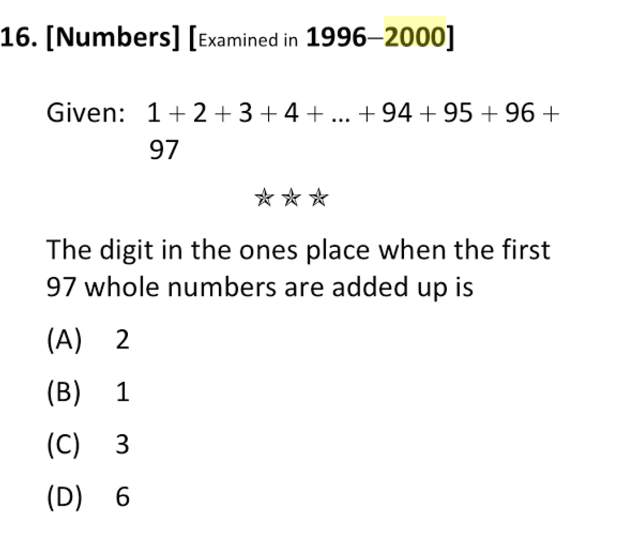
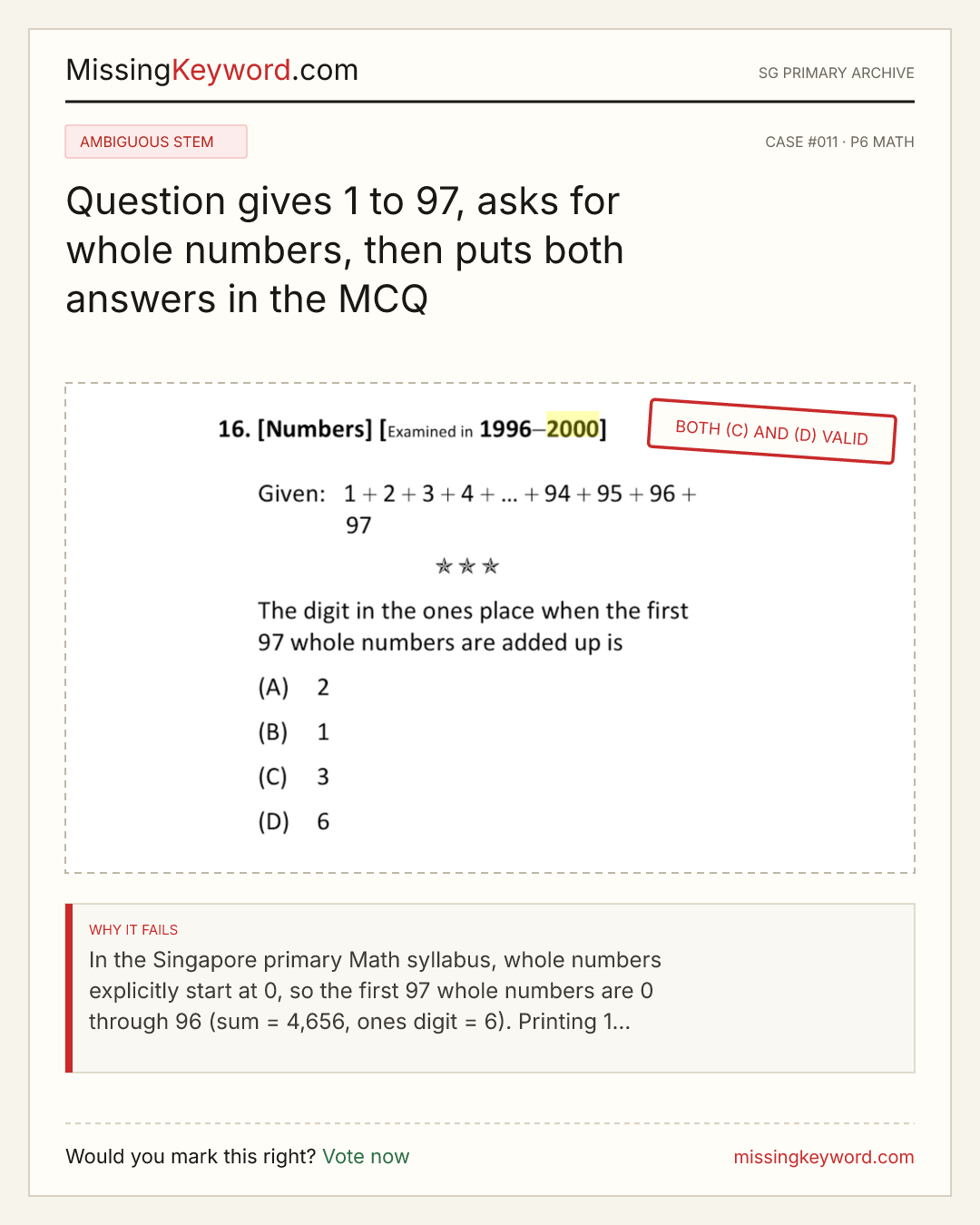
Classic PSLE Math exam question (1996–2000 archive, Mothership)
Blind Poll — Would you award the full / marks?
Vote above to reveal the parent split & forensic breakdown, or skip straight to verdict.
Ambiguous Stem
P6 Math
Awarded /
Forensic Verdict
The stem hands students the series 1 + 2 + ... + 97, then pivots to 'the first 97 whole numbers'—which in MOE's own syllabus start at zero. With both 3 and 6 sitting in the options, students are tested less on arithmetic than on guessing whether the setter forgot zero exists.
What the child demonstratedUnmarked question scan. A student following MOE's definition of whole numbers (0 to 96) calculates 4,656 and selects (D) 6; a student summing the printed 'Given' series (1 to 97) calculates 4,753 and selects (C) 3.
What the mark scheme demandedOption (C) 3, assuming 'the first 97 whole numbers' refers to the printed sum 1 + 2 + ... + 97 rather than 0 + 1 + ... + 96.
Why the question or marking failsIn the Singapore primary Math syllabus, whole numbers explicitly start at 0, so the first 97 whole numbers are 0 through 96 (sum = 4,656, ones digit = 6). Printing 1 through 97 as the 'Given' line while offering both 3 and 6 as MCQ options creates an unresolvable self-contradiction.
How a fair rubric would mark itChange 'first 97 whole numbers' to 'numbers from 1 to 97' (or 'first 97 counting numbers'), or award full marks to both (C) and (D).
Bonus ironyTagged as a three-star question from 1996–2000, suggesting zero was quietly deported from the whole numbers for at least four exam cycles.
Seen a worse deduction in your kid’s paper?
Submit a Scan →